


Twenty years after the revolutionarily simple “climate stabilization wedges” concept was first introduced to fundamentally change how we visualize the climate challenge, Prof. Haewon McJeon of the Graduate School of Green Growth and Sustainability at KAIST and Prof. Yang Ou of Peking University have reflected on a 20-year history of this framework in a new perspective article in Science. In the article titled “36 Solutions to Stabilize Earth’s Climate,” the authors look back at how a simple stabilization concept evolved into a participatory communications tool for global net-zero emissions.
Reflecting on a 20-Year Journey
The perspective looks back to 2004, when the original “stabilization triangle” suggested that the world needed only seven “wedges” of emissions reductions to avoid the worst effects of climate change. Reflecting on the two decades since, Prof. McJeon notes that the task has grown in both scale and urgency. With global fossil CO2 emissions hitting a record high of 42 Gt in 2024, the key difference is a sobering one: due to inaction in decarbonization, the 50-year runway envisioned in 2004 has been compressed into a 25-year sprint to 2050.
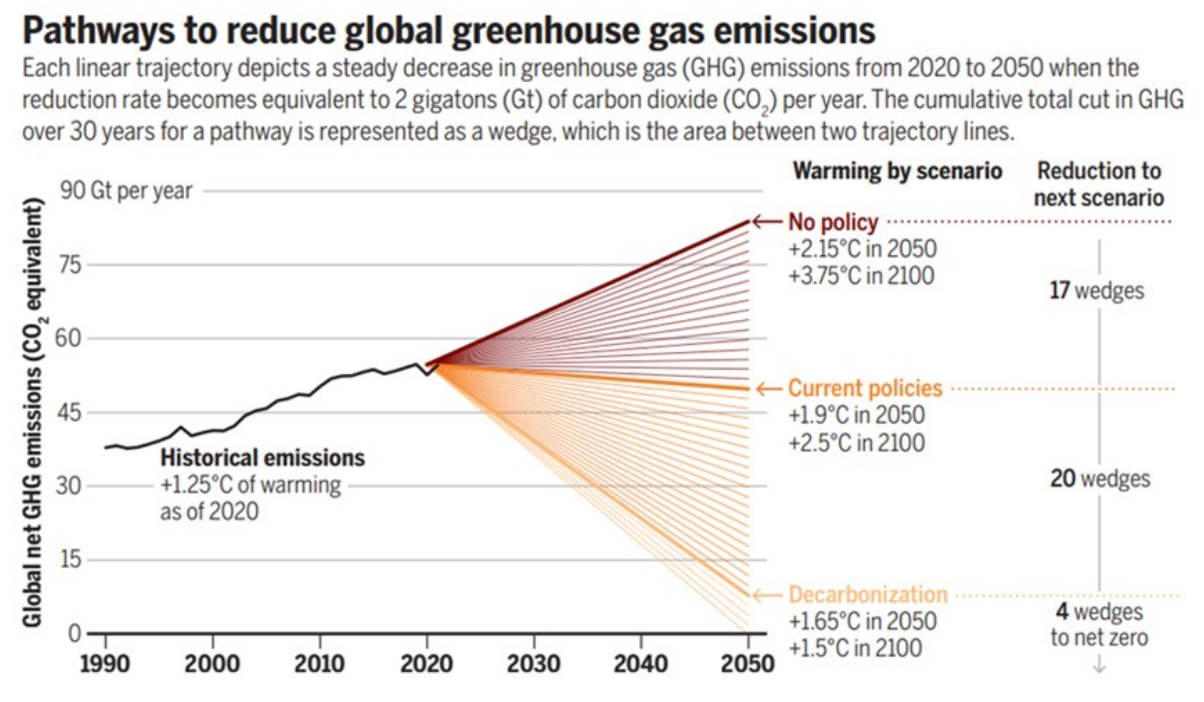
Fast forward to 2026: the authors evaluate how the modernized wedges framework, developed by Johnson and Staffell, has matured to meet this challenge. By standardizing a single “wedge” as 2 GtCO2 per year of avoided emissions by 2050, the new wedges framework is made more comprehensive and flexible:
- A Mirror to Diverse Portfolios: The original handful of solutions has blossomed into 36 strategies spanning electricity, transport, industry, buildings, and land use—reflecting the vast technological progress of the last two decades.
- Reflecting Societal Values: A central theme of the wedges framework is “Democratic Choice.” To limit warming to 1.5°C, only 20 of these 36 strategies are needed. This creates over 6 trillion possible combinations, indicating a research shift toward allowing individual users to choose pathways that align with their values and preferences.
- Expanding the Scope: The new framework now includes a broader set of “climate solutions” by including behavioral shifts like reduced meat consumption alongside technological fixes.
Bridging Science and Political Will
Prof. McJeon notes that while complex Integrated Assessment Models (IAMs) have become essential for technical validation, the simple “wedges” framework remains a useful tool for transparent public discourse. This synergy shows a more mature understanding of climate governance: societies must design preferred pathways that are both socially endorsed and scientifically rigorous.
“Looking back at twenty years of research, the binding constraint was never a technological ‘moonshot’ but implementation,” says Prof. McJeon. “The solutions have been available for more than a decade. What remains is the political will to mobilize finance, reform permitting, and maintain the mandate to act. Wedges excel at clarity and accessibility, helping stakeholders construct options that IAMs can then test for technical feasibility.”
About the Authors
Prof. Haewon McJeon is a leading expert in the decarbonization of the energy sector at the Graduate School of Green Growth and Sustainability, KAIST. His work focuses on the intersection of technology, economics, and policy.
Prof. Yang Ou is a leading expert in the integrated assessment modeling of emissions at the College of Environmental Sciences and Engineering, Peking University.
Links
- Link to Publication: https://www.science.org/doi/10.1126/science.aed5212
Prof. Haewon McJeon and Prof. Yang Ou
KAIST Graduate School of Green Growth and Sustainability
and PKU College of Environmental Sciences and Engineering
E-mail: hmcjeon@kaist.ac.kr
Homepage: https://kaist-iam.github.io/group/hmcjeon.html