


Professor Young Min Song’s group at KAIST has developed a high-density stretchable robotic vision platform that integrates single-crystalline silicon photodiodes with finely patterned liquid-metal interconnects, enabling multiscale imaging and depth sensing on mechanically deformable surfaces. The platform overcomes a longstanding trade-off in stretchable pixelated electronics among device performance, stretchability, integration density, and fill factor, while preserving a high active sensing area under mechanical deformation. The study was published in Nature Materials on 8 June 2026 (“Stretchable high-fill-factor silicon–liquid metal platform for multilevel visual acquisition and depth sensing”).
Conventional stretchable electronics typically achieve mechanical compliance through geometrically engineered structures such as serpentine interconnects, buckling, or kirigami, which often constrain pixel density and active sensing area. In contrast, the proposed monolithic fabrication approach enables the realization of image sensors with a fill factor of up to 81% and 100% biaxial stretchability, while maintaining a densely integrated sensing architecture. The resulting mechanical reconfigurability allows the sensor geometry to be actively adapted for different optical configurations and imaging functions beyond a conventional planar focal plane.
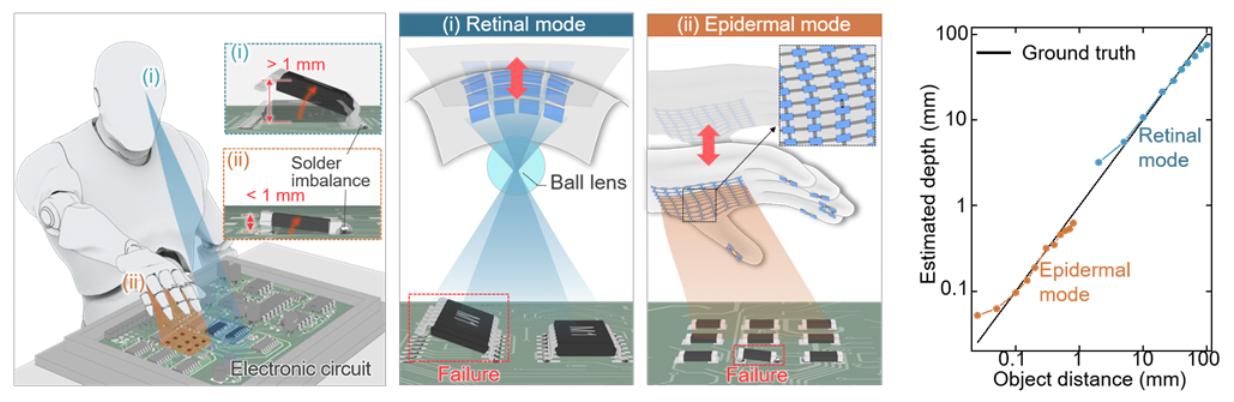
The stretchable platform supports two complementary bio-inspired imaging modes that enable multiscale visual acquisition and depth sensing. In the retinal mode, the sensor is curved and integrated with a single lens, enabling varifocal imaging, wide-field visual acquisition, and depth estimation at the macro-scale. In the epidermal mode, lens-free imaging directly captures nearby objects and provides fine depth information at the micro-scale. By combining these complementary sensing regimes, the system broadens the accessible depth range and enables hierarchical three-dimensional reconstruction of objects and scenes. This multiscale depth-sensing capability highlights the potential of stretchable electronics as active, shape-reconfigurable optical platforms for robotic vision, wearable imaging, skin-mounted sensing, and adaptive optoelectronics.
“Robotic vision systems increasingly require optical components that can adapt to changing environments rather than remaining fixed in shape and function,” said Prof. Young Min Song, the corresponding author. “This work provides a new direction for adaptive robotic optics by integrating mechanical reconfigurability directly into the imaging platform.”
This work was supported by the InnoCORE programme of the Ministry of Science and ICT (GIST InnoCORE KH0860). It was also partly supported by the International Technology Center Indo-Pacific (ITC IPAC) and the Army Research Office under contract no. FA5209-22-P-0162.

Prof. Young Min Song Electrical and Engineering, KAIST
E-mail: ymsong@kaist.ac.kr
Homepage: https://ymsong.net